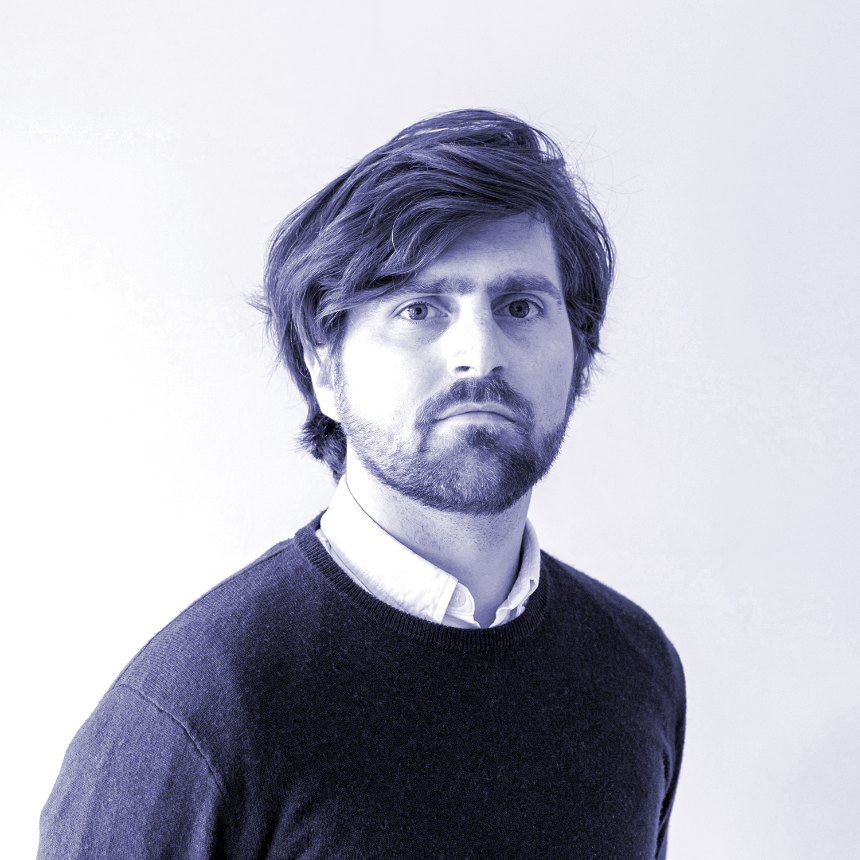
Franek Wardyński (b. 1989) is a multidisciplinary artist and designer based between London, Warsaw, and Stockholm. Wardyński’s main focus is on ways of narrating through critical art explorations, field projects, and research adventures. He explores concepts such as the cannibalisation of culture, land art, and matters of translation, through a diverse range of media including printmaking, sculpture, and performance. Specialising in visual experiences and new perspectives, his work incorporates multimedia creations and installations for museums, theatres, and operas.
Educated at the London College of Communication, Central Saint Martins, the Royal College of Art, and the College of Architecture at Texas Tech University, Wardyński founded his studio in 2015. During the past years, Wardyński has engaged in multiple art residencies and field projects, such as the Alps Art Academy for Land and Environmental Art in Switzerland and the Land Arts of the American West programme in 2019, as well as the Land Arts Adaptation programme in 2020, in Texas, USA.
https://www.franekwardynski.com/
Previous work


Project concept
During my research, I was struck by the beauty of the steel ring nets and hexagonal nets that cover the cliffs like a piece of fabric. I find it fascinating how these systems preserve the integrity of the rocks against their will and create a new relationship between humans, plants, and the earth. In my research document, I have included medium format and digital photographs of these instances from Elba and the French Alps.
In Tinos, I would like to delve further into this complex relationship between humans and nature and safety, perhaps by creating a lens-based project that documents work in the mines of Tinos or a physical object that expresses safety. I am enthusiastic about collaborating with the local community,
other artists, and researchers to gain a deeper understanding of the topic.
Rebar

Nestled on the island of Tinos, Greece, lies the Pyrgos marble quarry. It’s a site of great historical and cultural significance, with marble walls covered in drippings and streaks of rusted iron, serving as a testament to the impact of industrialisation on nature. It’s here that artist Franek Wardyński’s installation, Rebar, delicately hangs, suspended six meters above the ground on the western wall of the quarry.
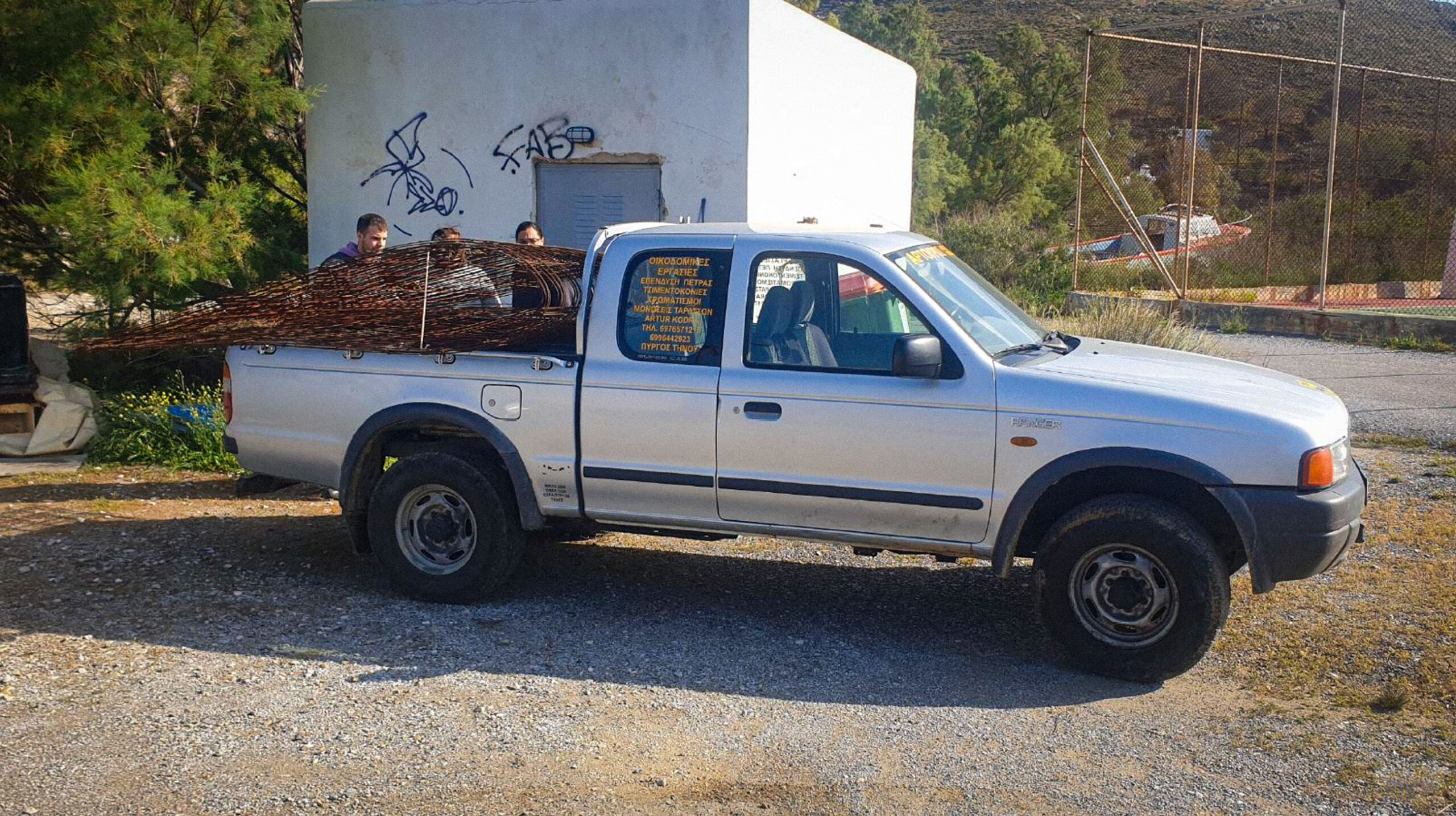
Rebar is an expression of the intersection between industry and nature. It measures 3 meters by 9 meters and is made from reclaimed iron, a common feature of the Tinian landscape and found in active marble quarries in the region of Exo Meria. The artwork blends with the wall and the surrounding environment, creating a sense of harmony between human and the natural world.
The installation refers to the geo-hazard meshing and grids of eroded mountain cliffs protecting people from falling rocks and boulders, offering a band-aid of care towards the mountain. The stoping face, signed by the miners, marks the end dates of extraction at the site, adding to the sense of history and decay in the quarry.
Rebar embodies a dark ecology motif, inviting us to consider the complex and often destructive relationship between humans and nature. The artwork serves as a reminder of the impact of our industrial practices on the planet and the role we must play in preserving it for future generations.
Photos