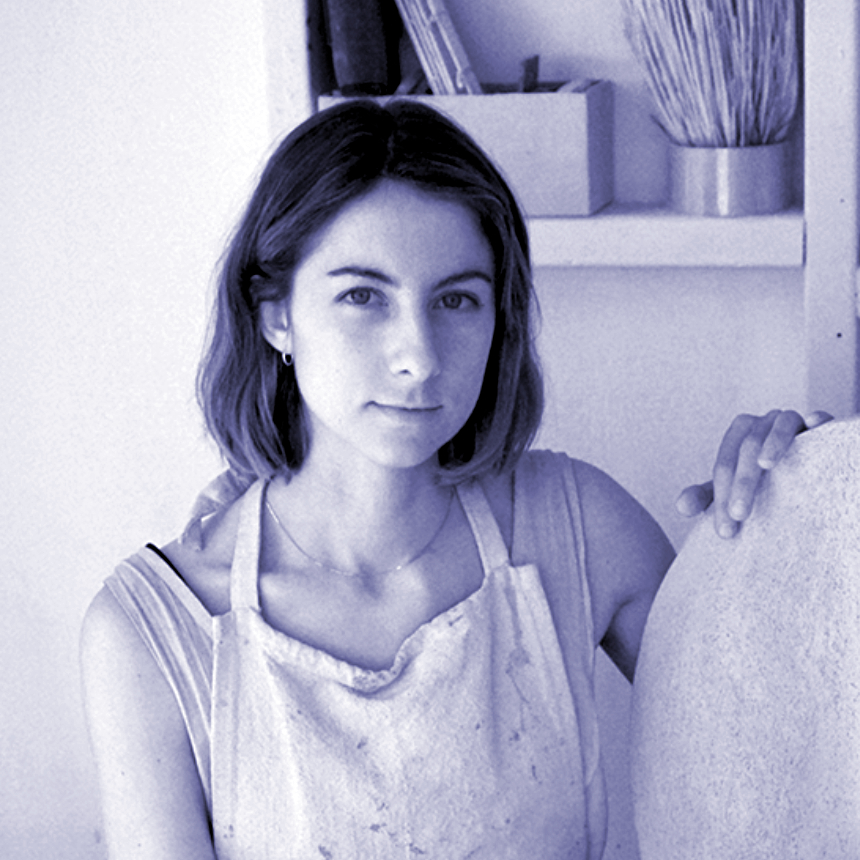
Lily Clark is an artist living between the Eastern Sierra and Los Angeles,
California. After receiving her BFA from the Maryland Institute College of Art in 2015, she began her ceramic studio practice and built a cross-disciplinary
process by using digital manufacturing methods like 3D printing to create
custom tools for extruding and shaping clay. Her work straddles both art and
design, and although she works with materials including stone, resin, wood, and metal, she considers water to be her primary medium. Her work has been featured by publications including Architectural Digest, Sight Unseen, and New York Magazine. In 2022, she exhibited new work with Stroll Garden Gallery, Some Clouds, and at Design Miami. This summer, she participated in a six week residency at Shiro Oni in Onishi, Japan, forging close connections with local stonemasons while sculpting three new water features using the local Sanbaseki stone.
Previous work


Project concept
After reflecting on the local water infrastructure vernacular and hydrogeology, I will design a piece intended to exist somewhere between natural spring and man-made fountain. Using local marble from
the quarry of Ag. Eleftheriou., I will create a water-based, site-specific sculpture meant to decay over time. While visiting local stonemasons, I hope to watch and learn the details of this craft, a symbol of collective identity and memory of place, as it has been passed down through generations. Though the piece will be made of stone, a seemingly everlasting material, it will serve as a record of entropy as my manipulations will gradually be altered and then erased by fluid dynamics.
Lintel Drop

In the process of marble mining, aligning to cardinal points is a crucial consideration due to the material’s anisotropic nature. The crystalline structure is influenced by magnetic poles, resulting in directionally dependent durability, refractive index, and susceptibility to erosion.
At the north face of Agios Eleftherios, there are visible traces of spring water seeping through vertical cracks. Similar to the marble, the hydraulic conductivity of Tinos’ groundwater is anisotropic, and soil texture, particle size distribution, and porosity can impact horizontal and vertical permeability.
I opted to install Lintel Drop on the north face, just below the seeping spring water, at the entrance to the toolshed. The piece features a thinly sliced, six-sided marble slab basin joined with the raw, iron-stained marble found on site. Lintel Drop includes a reservoir at the door’s head that slowly drips water into a basin over the course of a day. The basin has been intricately carved and sanded into a thin sheet, suggesting the possibility of erosion or breakage through the constant contact with water over time.
Lintel Drop draws inspiration from the marble fountains that can be found throughout Tinos, designed to guide and distribute the flow of spring water. Over the decades, these handcrafted features have been reshaped by the water they were intended to control, blurring the line between natural forces, ornamentation, and functionality.
Photos


